11. Hiroki Kuroda
2009-2011 averages: 28 games started, 11-12, 3.35 ERA, 172 IP, 1.177 WHIP, 7.1 K/9, 2.1 BB/9, 0.9 HR/9
Kuroda was one of the biggest names at the trade deadline in 2011, but like Aramis Ramirez, he decided he didn't want to leave his comfort zone. Kuroda could have swung a divisional race for a team in need of pitching, but instead remained with the Dodgers and finished off the best season of his career. His 3.07 ERA, 1.21 WHIP and career-high 161 strikeouts helped him to a fantastic contract year. The groundballer (48.6% groundball rate for his career) worked well in Chavez Ravine and his profile translates well to other parks as well. There were a couple concerning developments with his season however, including his 3.78 FIP (the highest in his career) and the unexplainable decrease in slider usage (thrown 21% in 2011 vs 31% in 2010). The change in his groundball rate coincides largely with his FIP, as his HR/9 skyrocketed this season to 1.07 HR/9, largely because he threw his sinker less and four-seam fastball more. His fastball is a good swing-and-miss pitch (21% swing-and-miss percentage), but the four-seam fastball is the easiest pitch to take yard, so Kuroda still needs to find a balance. He ditched his slider, which has historically been his second best pitch, and started throwing a curveball more, which was very effective. Most of Kuroda's repertoire was within the 84-92 MPH range, so adding a curveball in the mid-70's was smart, to help keep hitters off balance.
Overall, Kuroda may not be one of the best groundballers in the league due to his new approach, but he still isn't a flyball pitcher by any stretch of the imagination, and has the potential to be a #2 pitcher in many rotations. The question is, what team will commit multiple years to the 37-year-old? The Tigers and Red Sox were willing to trade for the right-hander last year, and I think plenty of teams, AL and NL alike, would be interested in enlisting his services for the next 2-3 years. However, Kuroda loves Los Angeles and has said he doesn't want to move unless it's back to Japan. It seems like Dodgers or bust here, and the Dodgers would be foolish not to re-sign the remarkably consistent veteran for one final contract.
Prediction: Dodgers; 2 years, $26 million
12. Mark Buehrle
2009-2011 averages: 32 games started, 13-11, 3.91 ERA, 210 IP, 1.316 WHIP, 4.5 K/9, 2.0 BB/9, 0.9 HR/9
Buehrle is one of the more consistent pitchers across baseball over his career, and while the way he does it isn't flashy, it's effective. His 4.5 K/9 is extremely slow, but the fast pace he works with on the mound and his above-average groundball rate make him a productive and quite useful pitcher. In 2011 he posted a 3.59 ERA, his lowest since 2005, and a near-normal FIP of 3.98 (3.90 FIP in 2010, 3.94 FIP in 2008), showing he consistently gets better results from his performance than the average pitcher with his peripherals (K/9, BB/9, HR/9) would. While his ERA usually hovers in the mid-3's to low 4's, it can't be overlooked how many innings he pitches each year. He's totaled over 200 innings in every full season of his career as a starter (11 consecutive from 2001-2011). As such a soft tosser (average fastball speed of 85 MPH), it seems that he doesn't toil too hard on the mound. This obviously isn't scientifically proven, but it seems that soft tossers like Jamie Moyer and Buehrle who use their changeup as an out pitch can pitch for decades, not just a few years. While it would seem that his slow pitches would be easier to focus in on, Buehrle has impeccable control and works so quickly on the mound that hitters remain off balance.
Buehrle is one of the prime pieces of this free agent market, and probably the most dependable commodity in the market, which should take him far. The White Sox would obviously like him back, but if it's to be believed they're trimming payroll, it's tough to see them re-signing him. Many teams could be interested, including the Marlins, Nationals, Yankees, Red Sox and others. I think the Marlins will be the biggest player for Buehrle along with Chicago, Buehrle has ties to Ozzie Guillen obviously in Florida and reportedly the manager is fighting for the front office to sign him. The Marlins may not want to pay CJ Wilson, so Buehrle seems to be the safer, more affordable option and I believe they'll get him.
Prediction: Marlins; 3 years, $40 million
13. David Ortiz
2009-2011 averages: 147 games, 30 HR, 99 RBI, 82 R, .272/.366/.515, 130 OPS+
Ortiz has enjoyed a revival of his career over the past two seasons, as his .881 OPS from 2009-2011 is dragged down by the .238/.332/.462 slash line he posted in 2009. Ortiz was phenomenal in 2011, hitting for a .953 ops and hitting over .300 for the first time since 2007 when he finished 4th in MVP voting. Big Papi was very impressive with the bat, reducing his K% to 13.7%, the lowest rate of his career and almost a 10% decrease from 2010. His walk rate isn't as high as it once was, but the walk rate hovering around 13% over the past two seasons is still quite impressive and shows that pitchers still fear the big DH. Another interesting part of Big Papi's season is that he hit for less power, but was more effective overall than in the past couple years. He hit 21% line drives (highest since 2005), and only hit 37.5% flyballs (the lowest figure of his career). The BABIP on line drives is more than 3 times as high as any other form of batted balls. The BABIP ranges from about .710 to .740 on line drives, depending on the season, so the higher the line drive rate, the more successful season a hitter will have. He hit .716 on line drives, .339 on fly balls, and .208 on ground balls. Ortiz's consistently high line drive rate means he still has the making of an elite middle-of-the-order hitter. This year, Big Papi even figured out his struggles against lefties, as he hit .329 against lefties and .298 against righties. Again, that seems to be a result of his line drive rate, as it was 23.6% against lefties this year. Studies show that players who lead in line drive rate one year rarely do the next, so I'd expect a drop back to about a 18% line drive rate (league average), but he can still easily post a season very similar to his 09-11 averages.
Ortiz's market suffers because he HAS to be a DH. Playing him at first base, even for a couple interleague games a year, is an adventure to say the least. The major suitors for Big Papi will be the Red Sox, Blue Jays, and possibly the Angels and Orioles. Because of his long history with the team, and because I think the Blue Jays will sign Prince Fielder (who will probably play plenty at DH), I expect Ortiz to return to the Red Sox on a 2 year deal with a vesting option for a 3rd year.
Prediction: Red Sox; 2 years, $24 million, 3rd year option for $12 million
14. Michael Cuddyer
2009-2011 averages: 150 games, 22 HR, 82 RBI, 85 R, .276/.341/.465, 117 OPS+
Cuddyer is one of the most versatile free agents available this offseason, and as a result has been one of the hottest names thus far in free agency rumors, with the Phillies, Twins, and Rockies already expressing interest in him. His OPS would likely be higher if he didn't play in a pitcher's park like Target Field, but he still posted an .805 OPS last season. Should he go to a more neutral or hitter-friendly park, he has 25 HR potential. Over the past two years, Cuddyer has spent time at 1B, 2B, 3B and RF. He reminds me a lot of a Ty Wigginton in his prime. He'll start 130-140 games a year, but probably no more than 100 at any one position. Cuddyer's versatility is a very valuable asset to a manager, as he can have no qualms sitting an infielder and playing Cuddyer at the position. Cuddyer becomes a more valuable player and helps keep the other starters rested as well. He's obviously more valuable at 2nd or 3rd base, despite the fact that his defense is probably below average at those positions. Cuddyer is a dead-red fastball hitter as we can see by looking at his pitch values. He was only an above-average hitter on fastballs (60% of the pitches he saw), and against splitters (he saw about 20 splitters all last year).
Cuddyer is in line for a 3 year deal as a utility infielder with a permanent starting role, and will likely move to the NL. Small-ball AL managers like Ron Gardenhire of the Twins, Mike Scioscia of the Angels, and Jim Leyland of the Tigers will also be interested in Cuddyer. Cuddyer's market will suffer because he's a type A free agent and likely to receive an arbitration offer from the Twins. Any team that signs him as a result will have to surrender their first round pick or an early 2nd round pick, and a division rival like the Tigers surely wouldn't be pleased with the sandwich pick the Twins also will receive upon Cuddyer's signing elsewhere. I think the Rockies and Phillies will dominate the market for him, with the Phillies ultimately winning out because they offer a better chance at making the World Series, something Cuddyer has come close to many times but never experienced.
Prediction: Phillies; 3 years, $30 million
15. Grady Sizemore
2009-2011 averages: 70 games, 9 HR, 36 RBI, 41 R, .234/.314/.413, 98 OPS+
Sizemore is probably the biggest risk of this free agency class, and as such, don't expect him to get more than a 2 year deal, but he's one of the most talented players available simultaneously. Formerly thought of as the best center fielder in baseball, Sizemore's never been able to stay healthy, and his stock has plummeted from perennial All-Star to questionable starter. Sizemore clearly doesn't have the health to remain in CF, and doesn't have the health to remain a threat on the basepaths (no stolen bases in 2 attempts over a 71 game sample last year). Ever since getting hurt, Sizemore's never been able to consistently post the numbers he once did as a perennial 30 HR, 30 SB threat from 2005-2008.
I can't think that Sizemore is realistically expected by any front office to play more than 100 games, but if he's moved to left field and can DH as well, he has a shot to play over 100 games and be a solid contributor. I think Chicago would be a solid spot for him to rehab his image on a one-year deal, similarly to the one-year deal Carlos Pena signed in 2011.
Prediction: Cubs; 1 year, $7 million
16. Ryan Madson
2009-2011 averages: 65 games, 2.78 ERA, 64 IP, 1.152 WHIP, 9.6 K/9, 2.4 BB/9, 0.6 HR/9
Madson finally got his first extended chance to close for the Phillies last year and flourished in the role, posting a career-low 2.37 ERA and 2.25 FIP, along with converting 32 of 34 save opportunities. Madson finally delivered on his promise, and was quite impressive. His changeup at 14.7 runs above average was the best of any reliever in baseball this year. The changeup is effective as it generates a lot of groundballs, and Madson threw it more than ever this year, posting a solid ground ball rate (48.3% ground balls). Madson largely ditched his cutter in another wise move, as he more than halved the frequency at which he threw it (18.1% in 2010, 8.4% in 2011). His cutter has always been his least effective pitch, so while it's useful as a pitch to keep batters off balance once in a while, it should be nothing more. Madson is also a very controlled pitcher, as in 2010 he posted a 1.04 WHIP and this past year pitched to a 1.15 WHIP. He doesn't complicate matters for himself, and that's the mark of a successful closer.
He'll have a large market, but I'm pretty sure the Phillies will realize they don't want to lose him. They've talked with Jonathan Papelbon, but he's so expensive that Madson seems the better option, especially given his ability to generate more ground balls.
Prediction: Phillies; 4 years, $36 million
Actual (11/8/2011): Phillies; 4 years, $44 million with 5th year option for $13 million
17. Edwin Jackson
2009-2011 averages: 32 games started, 12-10, 3.96 ERA, 208 IP, 1.363 WHIP, 7.1 K/9, 3.0 BB/9, 0.9 HR/9
Do you really know what you're getting from Edwin Jackson on a year-to-year basis? The simple, cursory answer to that riddle would be no, but over the past 3 years, Jackson seems to have become a little more predictable. He actually had a solid contract year, posting a 3.79 ERA over his time with the White Sox and Cardinals. Jackson K/BB rate was the best of his career (2.39 K/BB), and his 3.55 FIP was easily the lowest of his career (his 2010 season was his second lowest). The decline in FIP shows that he's improving a bit and his expectations should be higher than his 3.96 ERA over the past 3 years. He also was one out from posting his 3rd straight 200-inning season. Jackson's control was always his problem, as there was no question that his 95+ MPH fastball and solid slider were a great combination if he could harness them. He's throwing strikes more often than ever before, and his swing-and-miss percentage has hovered around 10% the past 3 years, a great rate for a starting pitcher.
Jackson was an absolute stud in Chicago actually, and while his ERA remained similar in St. Louis, his pitching approach fell off. Jackson totaled 5.1 WAR in his 30 starts with Chicago, and a 3.1 WAR in his 19 starts with Chicago in 2011. Upon getting to St. Louis, the results remained largely the same, but the way he got there was far more concerning. His fastball was 7.6 runs below the average fastball during his time in St. Louis, and given that he started 11 games, he surrendered almost an extra run per game by throwing his fastball too much and ditching his slider. His slider was more effective in St. Louis on a per-game basis, but his fastball was so poor, that it's clear the change in approach didn't help. Watching Jackson's tape from Chicago could teach his future team a lot about him.
The bright side for Jackson is that he had his best season to date while allowing a .330 BABIP and 25% Line Drive rate. While that seems contradictory, those rates are far above his career averages, and should regress back to more normal rates in 2012. The likely expectation for Edwin Jackson is that he posts a WAR between in the 3.6-3.8 range just like he has from 2009-2011, and that his ERA stays in the mid to high 3's. He's a useful middle of the rotation starter, and one that I think the Cubs would love to grab at this price. Jackson should end up being worth this contract over time,
Prediction: Cubs; 4 years, $40 million
18. Carlos Pena
2009-2011 averages: 144 games, 32 HR, 88 RBI, 76 R, .216/.346/.468, 120 OPS+
Carlos Pena revived his stock a little bit by taking a one-year deal in Chicago, and returned to an average above .200. However, he made it painfully obvious this season that he's a pure platoon player now. Pena posted a .225/.357/.462 slash line, the OBP being impressive as usual considering his low batting average, but against lefties, his performance was unacceptable. In 146 plate appearances, Carlos posted a pathetic .133/.260/.333 line, making him AAA fodder against left-handed pitchers. Against right-handers, Pena was an elite hitter, to the tune of .255/.388/.504, and hit 21 of his 28 home runs in 2011. Pena can be a fantastic hitter in a platoon role, where he'll still play 100+ games, and is a good fielder to boot, so his market in the NL may be stronger.
Pena would be a perfect fit for the Milwaukee Brewers to fill in for Prince Fielder after his departure on a one-year deal. If the Cubs want him, they have the inside track it seems, after his comments about being excited upon Theo Epstein's arrival in Chicago. I don't see him getting the $10 million that he got last year, mostly because Pujols, Fielder, and Cuddyer are the highly sought after first basemen, which depresses his stock to a mid-tier free agent.
Prediction: Brewers; 1 year, $8 million
19. Heath Bell
2009-2011 averages: 66 games, 2.36 ERA, 67 IP, 1.157 WHIP, 9.6 K/9, 3.2 BB/9, 0.4 HR/9
Bell was the most popular closer at the MLB Trade Deadline, but is he really worth the 3 year commitment he's looking for and $10 million per year? Bell's K/9 plummeted from 11.06 in 2010 to a more average 7.32 K/9 in 2011, and his FIP rose from 2.05 in 2010 to 3.23 in 2011. What was the reason for such a precipitous drop in 2011? It appears to be Bell's pitch selection. In 2011, Bell remained a fastball and curveball pitcher primarily, but he also threw a newly added sinker 15% of the time. Sinkers are well known as pitches that are thrown to contact in order to induce groundballs, so Bell's sinker largely functioned with that purpose. Bell generated less swing-and-misses with his fastball and also did the same with his curveball, so his struggles can't all be attributed to adding a sinker. Regardless though, the fact that he's old, isn't as dominant of a strikeout closer, and is leaving the most spacious park in baseball (Petco Park) will surely concern prospective suitors for Bell's services. Bell should still remain effective, but likely has seen his better days pass him by.
Bell has publicly stated he wants to remain in San Diego, and would accept a discount for them (he quoted 3 years, $27-30 million in July or August). He's also expressed interest in playing for the Angels or Dodgers, so it's clear he wants to remain on the West Coast. The only problem there is that Bell isn't going to command a $10 million salary elsewhere in all likelihood, so he's better off taking arbitration in hopes that the 2013 free agency class has less closers. Not to mention, he's a type-A free agent, so teams will be very hesitant to offer him a contract since they'd have to surrender their first round pick to do so.
Prediction: Padres; Bell accepts arbitration offer.
20. Josh Willingham
2009-2011 averages: 128 games, 23 HR, 72 RBI, 64 R, .257/.360/.479, 125 OPS+
Josh Willingham has always seemed to be one of the most underappreciated players in MLB to me, as his high OBP and above-average SLG% could help many teams, but instead he was left to take a one-year deal in Oakland, where his stock plummeted. He still had a fine season by posting an .810 OPS (.246/.332/.477), but the .246 average was the lowest of his career. He struck out more than ever before 26% strikeouts), and walked less than he had since his first full season (9.9% walks). Josh also swung at 21% of pitches outside the strike zone (more than ever before), and made contact on 75.7% of his swings, the lowest rate of his career. It honestly just looks like Willingham either regressed, or that he became more of a swing-for-the-fences player. I'm siding with the latter, because last year he also set his career highs in HRs (29) and RBIs (98). He knew he had to carry the load for the anemic Oakland offense, and apparently tried a little too hard to do so.
He's going to go under the radar again, and would be a great mid-level option for a team in need of a 6th hitter. He can DH, play first, and play corner outfield, so he's somewhat versatile at least. Willingham would be a perfect fit for a contender in need of a corner outfielder, and the Indians seem to be a good fit. They passed on trading for Willingham last year, but his availablility this year should intrigue them, as a Willingham-Brantley-Choo outfield would end their worries about the outfield for the foreseeable future.
Prediction: Indians; 3 years, $20 million
Showing posts with label hitters. Show all posts
Showing posts with label hitters. Show all posts
11/4/11
2012 MLB Free Agency Preview Top 50: 1-10
1. Albert Pujols:
2009-2011 averages: 155 games played, 42 HR, 117 RBI, 115 R, .313/.409/.598, 171 OPS+
I think we all know who this guy is by now. The predominant player of his generation, Albert Pujols is already a Hall of Famer, and still probably has 7-8 productive years left in him as a big leaguer (if not more). The facet of Pujols' game I've always been the most impressed with is his uncanny consistency from season to season. Had Albert gotten one more hit this season, he would have hit .300 for the 11th straight season. He has 30 HRs in every season, and fell 3 RBI short of an 11th straight 100 RBI season as well. So essentially, Albert Pujols is a lock for a .300+ average, 35 to 40 HRs and 100 RBI every season, which is remarkable. That's the reason he'll get paid.
Taking a deeper look at Pujols, it's really tough to find flaws, and one could say that we saw the beginning of the end of Pujols this year back in April. He hit .245/.305/.453 in the month and panic set in on every media network, while his .758 OPS in April and .752 OPS in May were unimpressive. The final four months of the year, he posted an OPS over .950 each month and hit 28 total HRs. This is Pujols' worst season ever, and he still posted a .906 OPS and 5.1 WAR season. There are concerning changes though, especially his walk rate plummeting from 14% to 9.4%, the lowest of his career. However, it's highly unlikely that this was anything but an aberration. Looking at Pujols' peripherals, his BABIP was very low, and the reason for such an occurrence seems fairly simple. Pujols hit far more ground balls than ever before (44% of batted balls were ground balls), and swung at pitches outside the zone more frequently than in any season (31.5%). Pujols seemed to be forcing his swing a bit, and his outside swings have actually increased more and more over the past four seasons. Coinciding with his increased swinging, Pujols' walk rate dropped each of the past two years, so I don't expect his walk rate to return to the astronomical 16.4% it was in 2009. His stats have definitely declined almost across the board the past three years, so that's something to watch, and the biggest concern with Pujols. As a 32-year-old player entering next season, does a team really want to commit to Pujols through his age-40 season? Unfortunately, that's the price the winning team will have to pay.
Pujols can be counted on for 150+ games, a .300/.400/.550 slash line, 30+ HRs and 100 RBI in the heart of a decent lineup for years to come, and that's invaluable. I wish GMs luck trying to put a price on it. He will get at least 7 years, if not a longer deal, and I fully expect one team to offer him $28 million a year, which would make him the top paid player in the history of MLB. Theo Epstein has stated publicly he won't go after Pujols or Fielder, but I don't buy it. More than half of the teams in baseball could show interest in Pujols, so his market is obviously the one to watch. I expect Pujols to get upwards of $200 million total easily, but I don't think he'll push the 10 year, $300 million deal that I expected prior to the year. Whatever team signs him will end up regretting it in about 4-5 years, just like the Yankees did with their extension on A-Rod's contract.
Prediction: St. Louis Cardinals; 9 years, $225 million
2009-2011 averages: 155 games played, 42 HR, 117 RBI, 115 R, .313/.409/.598, 171 OPS+
I think we all know who this guy is by now. The predominant player of his generation, Albert Pujols is already a Hall of Famer, and still probably has 7-8 productive years left in him as a big leaguer (if not more). The facet of Pujols' game I've always been the most impressed with is his uncanny consistency from season to season. Had Albert gotten one more hit this season, he would have hit .300 for the 11th straight season. He has 30 HRs in every season, and fell 3 RBI short of an 11th straight 100 RBI season as well. So essentially, Albert Pujols is a lock for a .300+ average, 35 to 40 HRs and 100 RBI every season, which is remarkable. That's the reason he'll get paid.
Taking a deeper look at Pujols, it's really tough to find flaws, and one could say that we saw the beginning of the end of Pujols this year back in April. He hit .245/.305/.453 in the month and panic set in on every media network, while his .758 OPS in April and .752 OPS in May were unimpressive. The final four months of the year, he posted an OPS over .950 each month and hit 28 total HRs. This is Pujols' worst season ever, and he still posted a .906 OPS and 5.1 WAR season. There are concerning changes though, especially his walk rate plummeting from 14% to 9.4%, the lowest of his career. However, it's highly unlikely that this was anything but an aberration. Looking at Pujols' peripherals, his BABIP was very low, and the reason for such an occurrence seems fairly simple. Pujols hit far more ground balls than ever before (44% of batted balls were ground balls), and swung at pitches outside the zone more frequently than in any season (31.5%). Pujols seemed to be forcing his swing a bit, and his outside swings have actually increased more and more over the past four seasons. Coinciding with his increased swinging, Pujols' walk rate dropped each of the past two years, so I don't expect his walk rate to return to the astronomical 16.4% it was in 2009. His stats have definitely declined almost across the board the past three years, so that's something to watch, and the biggest concern with Pujols. As a 32-year-old player entering next season, does a team really want to commit to Pujols through his age-40 season? Unfortunately, that's the price the winning team will have to pay.
Pujols can be counted on for 150+ games, a .300/.400/.550 slash line, 30+ HRs and 100 RBI in the heart of a decent lineup for years to come, and that's invaluable. I wish GMs luck trying to put a price on it. He will get at least 7 years, if not a longer deal, and I fully expect one team to offer him $28 million a year, which would make him the top paid player in the history of MLB. Theo Epstein has stated publicly he won't go after Pujols or Fielder, but I don't buy it. More than half of the teams in baseball could show interest in Pujols, so his market is obviously the one to watch. I expect Pujols to get upwards of $200 million total easily, but I don't think he'll push the 10 year, $300 million deal that I expected prior to the year. Whatever team signs him will end up regretting it in about 4-5 years, just like the Yankees did with their extension on A-Rod's contract.
Prediction: St. Louis Cardinals; 9 years, $225 million
2. Prince Fielder:
2009-2011 averages: 162 games played, 39 HR, 115 RBI, 97 R, .287/.409/.547, 155 OPS+
Prince is the second high-profile hitter available this offseason, and a fantastic middle of the order hitter to add to any lineup. Fielder posted the second best season of his career by pretty much any metric. His .299/.415/.566 line was only topped by his 2009 season. He had a 5.5 WAR season this year, and played almost every game again. Baseball analysts and executives alike have expressed concern about how Prince's 5'11" and 275 pound frame will hold up over the next 7 years, but Fielder has never missed more than 6 games in his career which sets those doubts aside. Separating the aspects that make up Wins Above Replacement (Batting, Fielding, Positional, Replacement, Base Running), Fielder was actually 5th in MLB in batting, making him the fifth most valuable hitter. That's pretty impressive especially considering that his WAR would be higher except that he plays at a traditional power hitting position (1st base is the easiest position to play, so WAR docks players accordingly).
For a guy named Fielder though, he sure doesn't acknowledge that part of the game. He was the fifth worst fielding first basemen in baseball (granted, the four worse fielders were far lower in grading). For this reason, it's likely he'll attract a heavy market in the AL, where teams can play him both at first base and slot him occasionally (or mainly) at DH.
Overall, I think Fielder is the second best free agent available, but the most interesting facet of this free agent group is the fact that its two premier players are at the same position. It'll be interesting to watch if he or Pujols sets the market for first basemen. I have a feeling Fielder will sign after Pujols, and likely for a deal approaching (if not surpassing) Mark Texieira's 8 year, $180 million deal ($22.5 million per year). If anyone in this offseason gets a deal longer than 7 years, it really should be Prince, as he's only 27. Most players hit their prime in their early 30s, so Prince would hypothetically only be beginning his decline towards the end of his deal.
Prediction: Blue Jays; 8 years, $185 million
3. Jose Reyes
2010-2011 averages: 130 games played, 9 HR, 49 RBI, 92 R, 34 SB, .309/.352/.460, 122 OPS+
Jose Reyes and C.C. Sabathia's free agent futures have been the central storylines of the New York baseball media this season. Well, C.C. signed an extension that'll guarantee him an extra $30 million, and C.C. only had to add one year to his deal ($25 million salary in 2016, and $5 million buyout in 2017 or $25 million salary in 2017). Reyes looks like he'll be the only one darting from the New York market, and his possibilities are limitless. Given that he's not a middle of the order hitter, he won't approach the Pujols and Fielder contracts. However, he is at an important defensive position, and offers a different type of threat to prospective buyers. His blazing speed gives pitching batteries fits trying to hold him down, and he's a feisty hitter at the plate, hitting .300 annually, as well as usually doing it at leadoff, putting his offense in a good position. Reyes' case for a big contract in 2011 actually seems to be about on par with Carl Crawford's argument in 2010. Reyes obviously has the injury history following him around, but he strikes out less than Carl Crawford and is a switch-hitter without a major split. He also plays a far more important defensive position (his fielding is average, but an average shortstop is still worth far more than a great left fielder) and doesn't complain about where he hits in the lineup. Crawford's public demand that he not be slotted at leadoff and that he hit third was ridiculous, and because of it, Crawford was the $142 million #7 hitter most of this year. Reyes at least will hit where he's set in the line-up and for that reason seems to be a better team player.
Reyes is the main reason I included the averages over multiple seasons. His 2011 season was above what can be reasonably expected from him (he hit .337/.384/.493 vs. his .292/.341/.441 career line, sound like Carl Crawford much?) and he's injury prone as demonstrated by his 130 game per season averagea. He's good for two DL stints a year in all likelihood (only one if he's lucky), and I had to omit 2009 from the average as he only played 36 games that year.
Reyes is set to be this free agent class' Carl Crawford. He won't get Crawford money, but he's going to get very, very close. I fully expect him to top $100 million and to push a Vernon Wells-caliber deal (7 years, $126 million). Unfortunately, in about four years, I'd expect Reyes' deal to look like just as much of an albatross as Wells' does. While Reyes is only 29 entering the 2012 season, he quite obviously had his career year, and while some speedsters maintain their swiftness on the basepaths through their careers, they lose power, and if Reyes loses the minimal power he has, he will be Juan Pierre at shortstop. Realistically, this is a .290/.350/.450 player at best, and I'm just not sure that an .800 OPS with speed at shortstop is worth $18-20 million a year through 2018 when plenty of guys in MLB could produce a somewhat similar OPS and make a third of what Reyes will make. Buyers beware.
Prediction: The Marlins make a major play at Reyes, but refuse to go high enough to meet Reyes' lofty demands. Brewers; 6 years, $110 million
4. C.J. Wilson, SP
2010-2011 averages: 16-8, 3.14 ERA, 214 IP, 1.215 WHIP, 7.9 K/9, 3.5 BB/9, 0.5 HR/9
C.J. Wilson may have divebombed in the playoffs, but he's still the best free agent pitcher available this year and will contend for a $100 million contract. I'm pretty sure he's priced himself out of that market though, and is more of a $80 million-ish pitcher on the open market now. I've always thought he'd get an A.J. Burnett type deal, and that's about what I'll project for him. The Rangers ace has only been a starter for two years, and the experiment has worked beautifully. He's been a solid starting pitcher, and realistically by the numbers, has been the equivalent of an up-and-coming ace. Wilson's topped 200 innings in both seasons, and kept the ball in the park in Arlington (49.3% ground balls, .5 HR/9). If you can pitch in Arlington, you can pitch anywhere.
An interesting point about Wilson's success was that he had the third lowest BABIP on groundballs, and that Wilson has induced more double plays than all but three MLB pitchers over the past two years. His performance will fall off at least slightly almost wherever he goes, as Kinsler, Andrus, Beltre is quite possibly the best defensive left side of an infield in baseball, but he's still a quality pitcher, and the best bet of any in this class. I see a middling team signing him to lead their rotation in a hopeful effort to make a playoff push.'
Prediction: The Nationals, Marlins, and Phillies all go in on him, but the Nationals come away with him on a 5 year, $85 million deal.
5. Yu Darvish, SP
I will be completely honest, I'm not very familiar with Yu Darvish's arsenal or scouting report, so for that, I'll turn to another source:
Darvish is only 25, so this is the best time to sign the young Japanese starter. As we know from the Daisuke Matsuzaka posting, first, an MLB team must make a silent bid for the RIGHTS to negotiate with Darvish. That will likely take $50+ million alone. After that, whatever team wins will have a 30-day negotiating period with him to agree on contract terms. If Darvish isn't satisfied with the contract, he will return to Nippon, and the Ham Fighters will receive $50 million just for offering Darvish up, so MLB teams place a premium on signing the player should they win his rights. Darvish has the highest upside of any pitcher in this class since he's so young, but also could bust out as many Japanese pitchers have. This is the ultimate risk/reward signing of this group, especially since teams have to pay $50 million up front to talk to him. This just screams Yankees, and I'm picking them to sign him.
Prediction: Yankees; $55 million posting fee, 6 years, $55 million
6. Aramis Ramirez, 3B
2009-2011 averages: 118 games played, 22 HR, 80 RBI, 62 R, .286/.344/.491, 120 OPS+
Ramirez was bandied about at the trade deadline, but he ultimately turned down the trades with his no trade clause, saying he wanted to remain in Chicago. However, now he's in free agency, and money talks far more when there's $40 million on the table elsewhere from a winning team. Ramirez is one of the better hitting 3rd basemen in baseball, as his .871 OPS was only behind Beltre's .896 OPS at 3rd base. This past year was Aramis' best since 2008, mainly because he stayed healthy for 149 games. Aramis is another one of those guys that you can count on hitting the DL once every year. Regardless, he's a valuable bat in any lineup. The biggest drawback of Aramis is that he is one of the worst fielding 3rd basemen in baseball. Fangraphs ranked him second worst of qualifying 3rd basemen (only Mark Reynolds was worse, and he was horrible). Any team signing him is doing so purely for the bat. Aramis surely wants at least a 3 year deal in FA, and possibly more. I don't see any team committing to more than 3 years for him, but he'll get a hefty payday.
Aramis may be a butcher in the field at third base, but his bat is one of the best at the position, and many teams could use him for that simple fact. He's a top ten third baseman probably right now, so contenders who need another bat in the lineup at 3B need to go for it with Aramis. There's one perfect situation for him, where he could play next to Jhonny Peralta, and finally put Brandon Inge back in Toledo where he belongs permanently.
Prediction: Tigers; 3 years, $39 million.
7. Jimmy Rollins, SS
2009-2011 averages: 128 games played, 15 HR, 60 RBI, 78 R, 26 SB, .255/.316/.403, 91 OPS+
Rollins is the second best shortstop available this offseason, and given that shortstop is a premium position, I fully expect him to draw more of a market than he should. Rollins is still an above average shortstop, but how far above average, and is he going to maintain the production over the four or five-year deal he is demanding? Looking at his stats really puts what he is in perspective.
Let's compare his 2006-2008 average to his 2009-2011:
2006-2008 averages: 152 games played, 22 HR, 79 RBI, 114 R, 41 SB, .284/.342/.485, 108 OPS+
2009-2011 averages: 128 games played, 15 HR, 60 RBI, 78 R, 26 SB, .255/.316/.403, 91 OPS+
It's a startling difference. 108 points of OPS difference changed him from an above average hitter at every position to an above average hitter (somewhat) only at shortstop. Rollins really isn't the same player he used to be. Part of that can be credited to the fact the Phillies' whole offense has declined over the past couple years, but before this year, they were an elite offense, that Rollins led off for. Additionally he seems to be a bigger injury risk now than he once was. Yet again, looking at the three year statistics shows that Rollins isn't quite the find in free agency that many thought he was. He's a good shortstop but nothing great, and certainly not worth the money he's going to see. On the bright side, he walks more than he once did. On the downside, his BABIP has been below .280 the past three years, and that's not a blip, that's a trend. His line drive rate is down on average, and his flyball rate is up, while he's not homering as much as in his prime. Rollins is still a useful shortstop, but don't get it twisted, he's nothing extremely special. Similarly to Pujols, it's tough to see Rollins, the face of the Phillies' resurgence, leaving the organization to go elsewhere. In a Jeter-esque move, will the Phillies overpay their shortstop because of his impact on the organization over time, and keep him in the fold due to lack of better options? I say no, because the Phillies have a young SS waiting in the wings for 2013, and don't want to pay him for the sake of paying him.
Prediction: Giants; 4 years, $50 million
8. Carlos Beltran, OF
2009-2011 averages: 96 games played, 13 HR, 53 RBI, 50 R, 6 SB, .298/.384/.497, 141 OPS+
Beltran managed to put together a full season this year, avoiding most injuries, and as a result posted a .910 OPS and 22 HRs. His performance didn't suffer in the Giants' poor lineup either, so Beltran looks to still be an elite hitter. The problem with him always has been and always will be his injury history. In 2009, he played 81 games and in 2010 played 64. He's a walking injury, moreso than almost any player in baseball. When he's on the field though, he's dynamic. He's a patient hitter as well, drawing walks in 12% of his at bats in 2011. Beltran's BABIP was a bit higher than normal (.324 vs. .303 career) and he also hit groundballs at an unusually low frequency (only 39% of batted balls) in combination with 21% line drives, but those statistics are close to his averages. Beltran can be counted on for an .875 OPS year-in and year-out still, but the counting stats are very unreliable. As far as his fielding goes, he's still an alright right fielder when healthy, but whatever team signs him will likely want to put him at DH often. Beltran expressed displeasure for DH'ing in July during trade talks, but the Red Sox can offer him a half-right field and half-DH job to prolong his health and appease his requests. It makes too much sense to me to not happen.
Prediction: Red Sox; 3 years, $39 million
9. Jonathan Papelbon, RP
2009-2011 averages: 65 games, 2.89 ERA, 66 IP, 1.119 WHIP, 10.8 WHIP, 2.8 BB/9, 0.7 HR/9
There is a glut of closers available this offseason, and despite the cries of "Papelblown" I hear coming from Boston right now, Papelbon is easily the best available reliever. In 2011 he had the best year of his career. He posted a 1.53 FIP along with 12.17 K/9, 1.4 BB/9, and a 0.42 HR/9. He seemed nearly unhittable this year, and posted a 3.0 WAR season, which is almost unthinkable for a reliever, especially considering that he only pitched in 63 games. Papelbon's pitch arsenal is pretty well-advertised by now, he's got a fastball that can touch high 90's or 100, and a slider and splitter that he throws about 25% combined just to keep batters honest. His breaking pitches were more effective this year than ever before, as his splitter was a full 2.3 runs above average for every 100 times he threw it, a phenomenal figure. His velocity is always constant and he's never really been an injury risk, but he's also never really been one to pitch more than one inning in an appearance. He pretty consistently averages exactly 1 inning per appearance and hasn't ever topped 67 appearances in his career, so for more liberal managers, Papelbon's usage may be a concern. But that's about the only downside to Papelbon, and it's not much of one, as most closers don't appear more than 70 times anyhow. The Red Sox can't afford to lose Papelbon, and will pay what it takes to keep him in the fold.
Prediction: Red Sox; 3 years, $45 million
10. Roy Oswalt, SP
2009-2011 averages: 10-10, 3.47 ERA, 28 starts, 177 IP, 1.18 WHIP, 7.2 K/9, 2.2 BB/9, 0.8 HR/9
The H2O rotation that was hyped beyond belief has come to a halt after a very short life, as Halladay and Hamels remain Phillies, while Oswalt's $16 million option was wisely declined. Oswalt's back problems have flared up again and seem to be haunting him as his career drags on. The fact of the matter is, it's tough to count on him for a full season. However, when he's on the mound, he's still a #2 pitcher in most rotations. His strikeouts have returned to their normal levels in 2011 after he posted an 8.2 K/9 in 2010. His FIP has always been great, and he posted a 3.44 FIP and 3.95 xFIP this year (3.35 FIP and 3.58 xFIP career). Oswalt does seem to be changing as a pitcher steadily but surely. The most noticeable change this year was the higher reliance on his fastball, throwing it 60% of the time in 2011 versus 55% in 2010. In 2010 when he threw his slider 15% of the time and his curve 10% of the time, he posted 2 more strikeouts per 9 innings, and a 2.76 ERA for the year. This year, he threw his fastball more, and his average velocity dropped a full mile per hour for the second consecutive year, but his combination of that and his changeup formed a formidable combination down the stretch of the season. This Fangraphs article goes into great detail about Oswalt's 2011 season and shows why there's reason to be optimistic about his future. He quickly realized that his sinker wasn't working and ditched it in favor of his fastball (which re-gained velocity as the season pressed on). He became a fastball-changeup pitcher after revamping his changeup grip in 2010, and it seems to have worked down the stretch for him. Removing May and June from his season, when he was potentially battling injury, Oswalt was a phenomenal starter.
He presents a bargain for a contender that needs a finishing piece. Teams that should inquire on Oswalt include Boston, Toronto, Detroit, Minnesota, the Angels, Nationals, Marlins, Mets, Cubs, and plenty of other teams. He'll attract a strong market, and he'll need no more than two years in all likelihood.
Prediction: Toronto; 2 years, $24 million
2009-2011 averages: 162 games played, 39 HR, 115 RBI, 97 R, .287/.409/.547, 155 OPS+
Prince is the second high-profile hitter available this offseason, and a fantastic middle of the order hitter to add to any lineup. Fielder posted the second best season of his career by pretty much any metric. His .299/.415/.566 line was only topped by his 2009 season. He had a 5.5 WAR season this year, and played almost every game again. Baseball analysts and executives alike have expressed concern about how Prince's 5'11" and 275 pound frame will hold up over the next 7 years, but Fielder has never missed more than 6 games in his career which sets those doubts aside. Separating the aspects that make up Wins Above Replacement (Batting, Fielding, Positional, Replacement, Base Running), Fielder was actually 5th in MLB in batting, making him the fifth most valuable hitter. That's pretty impressive especially considering that his WAR would be higher except that he plays at a traditional power hitting position (1st base is the easiest position to play, so WAR docks players accordingly).
For a guy named Fielder though, he sure doesn't acknowledge that part of the game. He was the fifth worst fielding first basemen in baseball (granted, the four worse fielders were far lower in grading). For this reason, it's likely he'll attract a heavy market in the AL, where teams can play him both at first base and slot him occasionally (or mainly) at DH.
Overall, I think Fielder is the second best free agent available, but the most interesting facet of this free agent group is the fact that its two premier players are at the same position. It'll be interesting to watch if he or Pujols sets the market for first basemen. I have a feeling Fielder will sign after Pujols, and likely for a deal approaching (if not surpassing) Mark Texieira's 8 year, $180 million deal ($22.5 million per year). If anyone in this offseason gets a deal longer than 7 years, it really should be Prince, as he's only 27. Most players hit their prime in their early 30s, so Prince would hypothetically only be beginning his decline towards the end of his deal.
Prediction: Blue Jays; 8 years, $185 million
3. Jose Reyes
2010-2011 averages: 130 games played, 9 HR, 49 RBI, 92 R, 34 SB, .309/.352/.460, 122 OPS+
Jose Reyes and C.C. Sabathia's free agent futures have been the central storylines of the New York baseball media this season. Well, C.C. signed an extension that'll guarantee him an extra $30 million, and C.C. only had to add one year to his deal ($25 million salary in 2016, and $5 million buyout in 2017 or $25 million salary in 2017). Reyes looks like he'll be the only one darting from the New York market, and his possibilities are limitless. Given that he's not a middle of the order hitter, he won't approach the Pujols and Fielder contracts. However, he is at an important defensive position, and offers a different type of threat to prospective buyers. His blazing speed gives pitching batteries fits trying to hold him down, and he's a feisty hitter at the plate, hitting .300 annually, as well as usually doing it at leadoff, putting his offense in a good position. Reyes' case for a big contract in 2011 actually seems to be about on par with Carl Crawford's argument in 2010. Reyes obviously has the injury history following him around, but he strikes out less than Carl Crawford and is a switch-hitter without a major split. He also plays a far more important defensive position (his fielding is average, but an average shortstop is still worth far more than a great left fielder) and doesn't complain about where he hits in the lineup. Crawford's public demand that he not be slotted at leadoff and that he hit third was ridiculous, and because of it, Crawford was the $142 million #7 hitter most of this year. Reyes at least will hit where he's set in the line-up and for that reason seems to be a better team player.
Reyes is the main reason I included the averages over multiple seasons. His 2011 season was above what can be reasonably expected from him (he hit .337/.384/.493 vs. his .292/.341/.441 career line, sound like Carl Crawford much?) and he's injury prone as demonstrated by his 130 game per season averagea. He's good for two DL stints a year in all likelihood (only one if he's lucky), and I had to omit 2009 from the average as he only played 36 games that year.
Reyes is set to be this free agent class' Carl Crawford. He won't get Crawford money, but he's going to get very, very close. I fully expect him to top $100 million and to push a Vernon Wells-caliber deal (7 years, $126 million). Unfortunately, in about four years, I'd expect Reyes' deal to look like just as much of an albatross as Wells' does. While Reyes is only 29 entering the 2012 season, he quite obviously had his career year, and while some speedsters maintain their swiftness on the basepaths through their careers, they lose power, and if Reyes loses the minimal power he has, he will be Juan Pierre at shortstop. Realistically, this is a .290/.350/.450 player at best, and I'm just not sure that an .800 OPS with speed at shortstop is worth $18-20 million a year through 2018 when plenty of guys in MLB could produce a somewhat similar OPS and make a third of what Reyes will make. Buyers beware.
Prediction: The Marlins make a major play at Reyes, but refuse to go high enough to meet Reyes' lofty demands. Brewers; 6 years, $110 million
4. C.J. Wilson, SP
2010-2011 averages: 16-8, 3.14 ERA, 214 IP, 1.215 WHIP, 7.9 K/9, 3.5 BB/9, 0.5 HR/9
C.J. Wilson may have divebombed in the playoffs, but he's still the best free agent pitcher available this year and will contend for a $100 million contract. I'm pretty sure he's priced himself out of that market though, and is more of a $80 million-ish pitcher on the open market now. I've always thought he'd get an A.J. Burnett type deal, and that's about what I'll project for him. The Rangers ace has only been a starter for two years, and the experiment has worked beautifully. He's been a solid starting pitcher, and realistically by the numbers, has been the equivalent of an up-and-coming ace. Wilson's topped 200 innings in both seasons, and kept the ball in the park in Arlington (49.3% ground balls, .5 HR/9). If you can pitch in Arlington, you can pitch anywhere.
An interesting point about Wilson's success was that he had the third lowest BABIP on groundballs, and that Wilson has induced more double plays than all but three MLB pitchers over the past two years. His performance will fall off at least slightly almost wherever he goes, as Kinsler, Andrus, Beltre is quite possibly the best defensive left side of an infield in baseball, but he's still a quality pitcher, and the best bet of any in this class. I see a middling team signing him to lead their rotation in a hopeful effort to make a playoff push.'
Prediction: The Nationals, Marlins, and Phillies all go in on him, but the Nationals come away with him on a 5 year, $85 million deal.
5. Yu Darvish, SP
I will be completely honest, I'm not very familiar with Yu Darvish's arsenal or scouting report, so for that, I'll turn to another source:
He is right-handed, and throws from a three-quarters arm slot in a drop-and-drive motion. He has bulked up in recent years and is around 220 pounds, and is tall- around 6’5″. His fastball is in the 94 to 97 range. He has a 80mph slider-curveball combo pitch with a great break. He also throws a bunch of other pitches to confuse batters, such as cutter, change-up, two-seam fastball, and splitter. He stopped using the screwball because he got injured using it. His work ethic, conditioning, and stamina are legendary.If you're interested, his final start for Nippon can be watched here. And this link charts each pitch he threw through the game in order, classifying the type of pitch and the speed of each pitch. He does have great stuff, you can tell even from watching a limited portion of the game, but I did think he was somewhat wild.
Darvish is only 25, so this is the best time to sign the young Japanese starter. As we know from the Daisuke Matsuzaka posting, first, an MLB team must make a silent bid for the RIGHTS to negotiate with Darvish. That will likely take $50+ million alone. After that, whatever team wins will have a 30-day negotiating period with him to agree on contract terms. If Darvish isn't satisfied with the contract, he will return to Nippon, and the Ham Fighters will receive $50 million just for offering Darvish up, so MLB teams place a premium on signing the player should they win his rights. Darvish has the highest upside of any pitcher in this class since he's so young, but also could bust out as many Japanese pitchers have. This is the ultimate risk/reward signing of this group, especially since teams have to pay $50 million up front to talk to him. This just screams Yankees, and I'm picking them to sign him.
Prediction: Yankees; $55 million posting fee, 6 years, $55 million
6. Aramis Ramirez, 3B
2009-2011 averages: 118 games played, 22 HR, 80 RBI, 62 R, .286/.344/.491, 120 OPS+
Ramirez was bandied about at the trade deadline, but he ultimately turned down the trades with his no trade clause, saying he wanted to remain in Chicago. However, now he's in free agency, and money talks far more when there's $40 million on the table elsewhere from a winning team. Ramirez is one of the better hitting 3rd basemen in baseball, as his .871 OPS was only behind Beltre's .896 OPS at 3rd base. This past year was Aramis' best since 2008, mainly because he stayed healthy for 149 games. Aramis is another one of those guys that you can count on hitting the DL once every year. Regardless, he's a valuable bat in any lineup. The biggest drawback of Aramis is that he is one of the worst fielding 3rd basemen in baseball. Fangraphs ranked him second worst of qualifying 3rd basemen (only Mark Reynolds was worse, and he was horrible). Any team signing him is doing so purely for the bat. Aramis surely wants at least a 3 year deal in FA, and possibly more. I don't see any team committing to more than 3 years for him, but he'll get a hefty payday.
Aramis may be a butcher in the field at third base, but his bat is one of the best at the position, and many teams could use him for that simple fact. He's a top ten third baseman probably right now, so contenders who need another bat in the lineup at 3B need to go for it with Aramis. There's one perfect situation for him, where he could play next to Jhonny Peralta, and finally put Brandon Inge back in Toledo where he belongs permanently.
Prediction: Tigers; 3 years, $39 million.
7. Jimmy Rollins, SS
2009-2011 averages: 128 games played, 15 HR, 60 RBI, 78 R, 26 SB, .255/.316/.403, 91 OPS+
Rollins is the second best shortstop available this offseason, and given that shortstop is a premium position, I fully expect him to draw more of a market than he should. Rollins is still an above average shortstop, but how far above average, and is he going to maintain the production over the four or five-year deal he is demanding? Looking at his stats really puts what he is in perspective.
Let's compare his 2006-2008 average to his 2009-2011:
2006-2008 averages: 152 games played, 22 HR, 79 RBI, 114 R, 41 SB, .284/.342/.485, 108 OPS+
2009-2011 averages: 128 games played, 15 HR, 60 RBI, 78 R, 26 SB, .255/.316/.403, 91 OPS+
It's a startling difference. 108 points of OPS difference changed him from an above average hitter at every position to an above average hitter (somewhat) only at shortstop. Rollins really isn't the same player he used to be. Part of that can be credited to the fact the Phillies' whole offense has declined over the past couple years, but before this year, they were an elite offense, that Rollins led off for. Additionally he seems to be a bigger injury risk now than he once was. Yet again, looking at the three year statistics shows that Rollins isn't quite the find in free agency that many thought he was. He's a good shortstop but nothing great, and certainly not worth the money he's going to see. On the bright side, he walks more than he once did. On the downside, his BABIP has been below .280 the past three years, and that's not a blip, that's a trend. His line drive rate is down on average, and his flyball rate is up, while he's not homering as much as in his prime. Rollins is still a useful shortstop, but don't get it twisted, he's nothing extremely special. Similarly to Pujols, it's tough to see Rollins, the face of the Phillies' resurgence, leaving the organization to go elsewhere. In a Jeter-esque move, will the Phillies overpay their shortstop because of his impact on the organization over time, and keep him in the fold due to lack of better options? I say no, because the Phillies have a young SS waiting in the wings for 2013, and don't want to pay him for the sake of paying him.
Prediction: Giants; 4 years, $50 million
8. Carlos Beltran, OF
2009-2011 averages: 96 games played, 13 HR, 53 RBI, 50 R, 6 SB, .298/.384/.497, 141 OPS+
Beltran managed to put together a full season this year, avoiding most injuries, and as a result posted a .910 OPS and 22 HRs. His performance didn't suffer in the Giants' poor lineup either, so Beltran looks to still be an elite hitter. The problem with him always has been and always will be his injury history. In 2009, he played 81 games and in 2010 played 64. He's a walking injury, moreso than almost any player in baseball. When he's on the field though, he's dynamic. He's a patient hitter as well, drawing walks in 12% of his at bats in 2011. Beltran's BABIP was a bit higher than normal (.324 vs. .303 career) and he also hit groundballs at an unusually low frequency (only 39% of batted balls) in combination with 21% line drives, but those statistics are close to his averages. Beltran can be counted on for an .875 OPS year-in and year-out still, but the counting stats are very unreliable. As far as his fielding goes, he's still an alright right fielder when healthy, but whatever team signs him will likely want to put him at DH often. Beltran expressed displeasure for DH'ing in July during trade talks, but the Red Sox can offer him a half-right field and half-DH job to prolong his health and appease his requests. It makes too much sense to me to not happen.
Prediction: Red Sox; 3 years, $39 million
9. Jonathan Papelbon, RP
2009-2011 averages: 65 games, 2.89 ERA, 66 IP, 1.119 WHIP, 10.8 WHIP, 2.8 BB/9, 0.7 HR/9
There is a glut of closers available this offseason, and despite the cries of "Papelblown" I hear coming from Boston right now, Papelbon is easily the best available reliever. In 2011 he had the best year of his career. He posted a 1.53 FIP along with 12.17 K/9, 1.4 BB/9, and a 0.42 HR/9. He seemed nearly unhittable this year, and posted a 3.0 WAR season, which is almost unthinkable for a reliever, especially considering that he only pitched in 63 games. Papelbon's pitch arsenal is pretty well-advertised by now, he's got a fastball that can touch high 90's or 100, and a slider and splitter that he throws about 25% combined just to keep batters honest. His breaking pitches were more effective this year than ever before, as his splitter was a full 2.3 runs above average for every 100 times he threw it, a phenomenal figure. His velocity is always constant and he's never really been an injury risk, but he's also never really been one to pitch more than one inning in an appearance. He pretty consistently averages exactly 1 inning per appearance and hasn't ever topped 67 appearances in his career, so for more liberal managers, Papelbon's usage may be a concern. But that's about the only downside to Papelbon, and it's not much of one, as most closers don't appear more than 70 times anyhow. The Red Sox can't afford to lose Papelbon, and will pay what it takes to keep him in the fold.
Prediction: Red Sox; 3 years, $45 million
10. Roy Oswalt, SP
2009-2011 averages: 10-10, 3.47 ERA, 28 starts, 177 IP, 1.18 WHIP, 7.2 K/9, 2.2 BB/9, 0.8 HR/9
The H2O rotation that was hyped beyond belief has come to a halt after a very short life, as Halladay and Hamels remain Phillies, while Oswalt's $16 million option was wisely declined. Oswalt's back problems have flared up again and seem to be haunting him as his career drags on. The fact of the matter is, it's tough to count on him for a full season. However, when he's on the mound, he's still a #2 pitcher in most rotations. His strikeouts have returned to their normal levels in 2011 after he posted an 8.2 K/9 in 2010. His FIP has always been great, and he posted a 3.44 FIP and 3.95 xFIP this year (3.35 FIP and 3.58 xFIP career). Oswalt does seem to be changing as a pitcher steadily but surely. The most noticeable change this year was the higher reliance on his fastball, throwing it 60% of the time in 2011 versus 55% in 2010. In 2010 when he threw his slider 15% of the time and his curve 10% of the time, he posted 2 more strikeouts per 9 innings, and a 2.76 ERA for the year. This year, he threw his fastball more, and his average velocity dropped a full mile per hour for the second consecutive year, but his combination of that and his changeup formed a formidable combination down the stretch of the season. This Fangraphs article goes into great detail about Oswalt's 2011 season and shows why there's reason to be optimistic about his future. He quickly realized that his sinker wasn't working and ditched it in favor of his fastball (which re-gained velocity as the season pressed on). He became a fastball-changeup pitcher after revamping his changeup grip in 2010, and it seems to have worked down the stretch for him. Removing May and June from his season, when he was potentially battling injury, Oswalt was a phenomenal starter.
He presents a bargain for a contender that needs a finishing piece. Teams that should inquire on Oswalt include Boston, Toronto, Detroit, Minnesota, the Angels, Nationals, Marlins, Mets, Cubs, and plenty of other teams. He'll attract a strong market, and he'll need no more than two years in all likelihood.
Prediction: Toronto; 2 years, $24 million

10/25/11
2012 MLB Free Agents: Catchers
With the offseason rapidly approaching, I'll be previewing the free agents available at each position for the 2012 MLB season. I'll provide as detailed of an analysis of each player's season as possible, and attempt to project their future earnings or destinations if possible. First up on the list: Catchers.
Admittedly, this is a weak market for catchers, and some GMs claim it's a weak market overall. I don't buy that it's weak overall, but certainly, I agree with the notion that finding a starting catcher this offseason will be tough for teams. There's really only one good starting catcher available (Ramon Hernandez), and the rest are platoon players or miscast as catchers (I'm looking at you Jorge Posada and Ryan Doumit). Regardless of what I just said though, there is still value to be found in this free agent catcher group, so let's dive in and take a look at the available catchers in the 2011-12 offseason.
Admittedly, this is a weak market for catchers, and some GMs claim it's a weak market overall. I don't buy that it's weak overall, but certainly, I agree with the notion that finding a starting catcher this offseason will be tough for teams. There's really only one good starting catcher available (Ramon Hernandez), and the rest are platoon players or miscast as catchers (I'm looking at you Jorge Posada and Ryan Doumit). Regardless of what I just said though, there is still value to be found in this free agent catcher group, so let's dive in and take a look at the available catchers in the 2011-12 offseason.
Ryan Doumit (.303/.353/.477, 8 HR, 30 RBI, 1.8 WAR in 236 PA): Doumit is easily the most talented hitter of the group available in free agency this offseason, now that his 2012-2013 option has been declined (2 years, $15.5 million). You don't find switch-hitting catchers with little to no split that can OPS over .800 in free agency often, so he'll be a highly sought after name, and the Pirates will miss him greatly. The problem is, he's also the biggest defensive liability behind the plate of arguably any catcher in baseball. Doumit is terrible at framing pitches (in this Baseball Prospectus study, he's the poster child for what not to do when framing pitches, along with Jason Varitek) and only caught 11 of 90 steal attempts in 2010 (100 games played).
Players are encouraged to run on Doumit, probably more than against any catcher not named Jason Varitek, as he sees almost one steal attempt per game (the most attempted steals against a team this year was 153 against the Red Sox, almost 1 per game, to put that in perspective). Doumit's bat and versatility, however, are special, and make his defensive liabilities tolerable when he can OPS .830. Doumit has played outfield and first base for Pittsburgh as well, but operated more often than not as a catcher. Doumit would look very appealing to an AL team as a DH and backup catcher option, or a full-time catcher for a team looking to make a cheap addition. Due to Doumit's injury history, he probably won't get a long-term deal, but could net a deal in the neighborhood of 3 years with vesting options included. If an AL team signs him and allows him to DH and catch, he may be able to play a full season. I'd expect a 3 year deal for about $20 million, which is similar to the top contract in free agency for a catcher last year (John Buck's 3 year, $18 million deal from the Marlins).
Ramon Hernandez (.282/.341/.446, 12 HR, 36 RBI, 2.0 WAR in 328 PA): Hernandez is the crown jewel of this offseason's weak market for free agent catchers, although that's not to say he's a weak addition to any team. He doesn't have a huge platoon split, meaning he can be a starting catcher for nearly a full season. His .787 OPS ranked 8th in baseball of all catchers with 250 or more ABs, meaning he's definitely an above-average catcher, and was a borderline elite hitter as a catcher in 2011. He's still got solid power in his bat, and is a fairly patient hitter at the plate.
The drawbacks with Hernandez are three-fold:
Chris Snyder (.271/.376/.396, 3 HR, 17 RBI, 0.7 WAR in 119 PA): Declining Snyder's option was a no-brainer for the Pirates as he went on the 60-day DL to end his season in June due to requiring his 2nd back surgery in as many years. Now, Snyder hits the free agent market and could be an interesting bargain for someone this year. Obviously, no one will enter the season counting on Snyder to be their primary starter, but he becomes more interesting, as it looked like this was set to be the breakout season that many (including myself) expected from Snyder after his 2007 and 2008 seasons with the Diamondbacks. He hit for average for the first time in his career, and still showcased his ridiculous walk rate (13.8% is his lowest BB% over the past 4 years, which is outstanding). Even when Snyder hits .220, he's more than likely going to be a .350 OBP guy, making him pretty useful. According to the BP study I've referenced multiple times, Snyder's an above average catcher at framing pitches, and had already saved his team 7 runs with his work in 34 games in 2011 before his injury. Snyder's a gamble, there's no doubt, but he can be a serviceable backup at the least, with a ceiling of his 2011 production rates. More likely, his hitting will drop back to his career averages (.231/.333/.394), but that's a fantastic backup and passable starter if just taking his bat into consideration. He'll find work somewhere, and it may just be back in Pittsburgh.
Kelly Shoppach (.176/.268/.339, 11 HR, 22 RBI, 1.1 WAR in 253 PA): Shoppach's line looks dreadful, and that's because it is. But hidden beneath the .607 OPS, Shoppach was a fine platoon hitter and can serve that purpose well for another team. He hit .244/.344/.444 in his 125 plate appearances against left-handed pitchers, and this trend stretches back for years. For some reason, the Rays didn't want to utilize him in the best way possible, and gave him more plate appearances against right-handed pitchers than lefties (.115/.192/.239 vs RHP), which they paid for according to DRaysBay:
Jose Molina (.281/.342/.415, 3 HR, 15 RBI, 1.3 WAR in 191 PA): This was very unexpected, as Molina's career line is .241/.286/.344. It's fairly easy to explain though. The small sample size, plus a .363 BABIP (his career mark is .293), means that Molina will fall back to earth a bit this year. Molina is a solid defensive catcher though. He does suffer in blocking wild pitches (which is unfortunate, as Toronto led the league in wild pitches), but is the best in baseball at getting strikes called on questionable pitches, and that's an invaluable skill. To put in perspective how much better Jose Molina is than every other catcher, Baseball Prospectus prepared a graph that helped compose a linear model for extra strikes called per pitch:
Molina is worlds ahead of everyone else, saving 35 runs every 120 games by getting more called strikes. It's unlikely that front offices will actually take this into consideration enough, because if they did, they would make Molina a full time catcher, as he'd be worth nearly 3.5 wins above replacement, just based on his catching ability. Molina should be able to net a better contract since he had an OPS over .750 this season (in limited at bats albeit), so look for him to get about $3-4 million per year if GMs take attention to him.
Jason Varitek (.221/.300/.423, 11 HR, 36 RBI, 0.5 WAR in 250 PA): Jason Varitek may have exhausted his time as a Red Sox catcher, so will anyone else be interested in his services? The Red Sox like Ryan Lavarnway to be a young, affordable catcher (he posted a .738 OPS in his 43 plate appearances in MLB, and started down the stretch for the Red Sox), and Jarrod Saltalamacchia will remain on the Red Sox, likely as the full-time catcher. He caught 103 games last year and posted a .738 OPS as well (what an odd coincidence). Varitek made $5 million last year, and surely won't command that again, wherever he looks to go. Varitek is additionally the worst catcher behind the plate, whether it's throwing out runners or framing pitches.
He can still post a decent OPS for a catcher, but he also only played in 68 games last year, which is about right for him.
Jorge Posada (.235/.315/.398, 14 HR, 44 RBI, -0.4 WAR in 388 PA): For a catcher, Posada's hitting is tolerable, but is his defense up to par behind the plate, and can his aging body hold up behind the plate? Posada apparently believes so, and thinks he can still contribute as a backstop:
Rod Barajas (.230/.287/.430, 16 HR, 47 RBI, 1.3 WAR in 337 PA): Barajas has stated that he wants to end his career in a Dodgers uniform, but GM Ned Colletti has made it known that's unlikely, as he said the Dodgers want to "get younger" at catcher in 2012, so Barajas will likely test the market. His statline reminds me of Miguel Olivo; A low .200s batting average, a sub-.300 OBP and a .400+ SLG with about 20 HRs. Barajas is probably a better defensive catcher, while Olivo has a far better arm when throwing out basestealers. I'll cut out the comparison now, but you understand the point I'm getting across; in the free agent market, Barajas and Olivo have very similar values. Barajas will be 36 to open the 2012 season, and likely will command a one year deal, as he has the last two seasons with the Mets in 2010 and Dodgers in '11. Olivo got a 2 year, $7 million deal with the Mariners after his career year in Colorado (a career year for a power hitter in Colorado? Unheard of.), and Barajas will probably HOPE for the same. Barajas signed a 1 year, $3.25 million deal in LA last year, and should command a similar salary again, as his 2011 season is almost a carbon copy of his 2010 season. He's a low-end starting option or mentor for an up-and-coming catcher in all likelihood. The Dodgers could consider him again, but AJ Ellis was impressive in his short MLB stint last year, so I'd expect Ellis to take over full-time catching.
Ivan Rodriguez (.218/.281/.323, 2 HR, 19 RBI, 0.4 WAR in 137 PA): Pudge is far past his prime, but he still actually presents a solid backup option for a team with a young catcher. He worked with Wilson Ramos and Jesus Flores the past couple years in Washington, and likely will get one more MLB opportunity this offseason on a short deal (I'm guessing 1 year, $2 million). Pudge actually threw out 52% of runners in his short time (13 of 25 basestealers), so his defensive prowess remains a constant. Unfortunately, he has no power whatsoever, and his discipline this year was uncharacteristically high, as his 7.0% walk rate was his highest since 2004 with the Tigers. He's a good "veteran presence" and "mentor" and all that other terminology for an old big-name player that will be in the Hall of Fame. He'll get a contract on name basis and because his defense and game calling are fantastic.
Matt Treanor (.214/.338/.291, 3 HR, 22 RBI, 0.7 WAR in 242 PA): Treanor isn't very impressive anymore, and is one of the worst catchers in baseball at framing pitches (he cost his team 17 runs according to Baseball Prospectus). It's highly unlikely he's very sought after, and he may just remain with the Rangers or retire. While Treanor posts a solid walk rate (14% in 2011), he doesn't do anything else well, and for that reason, teams would be wise to pass him over and opt for an in-house option.
Dioner Navarro (.193/.276/.324, 5 HR, 17 RBI, -0.1 WAR in 202 PA): Dioner Navarro is in the same boat as Treanor. He'll likely be a minor league contract invited to camp, but nothing more. His defense and arm are average now, and the upside he once had as a Ray never materialized.
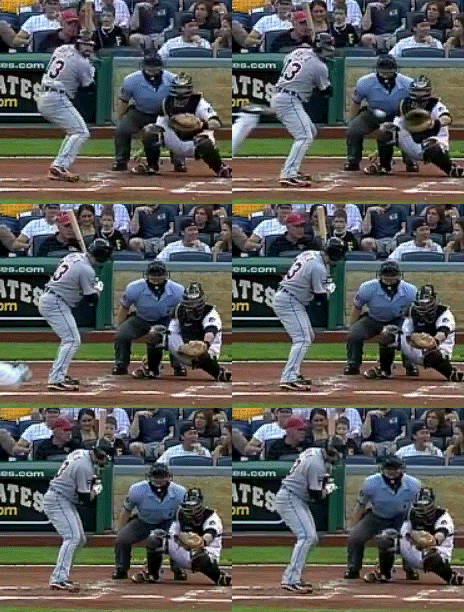 |
| Did I catch it? |
Players are encouraged to run on Doumit, probably more than against any catcher not named Jason Varitek, as he sees almost one steal attempt per game (the most attempted steals against a team this year was 153 against the Red Sox, almost 1 per game, to put that in perspective). Doumit's bat and versatility, however, are special, and make his defensive liabilities tolerable when he can OPS .830. Doumit has played outfield and first base for Pittsburgh as well, but operated more often than not as a catcher. Doumit would look very appealing to an AL team as a DH and backup catcher option, or a full-time catcher for a team looking to make a cheap addition. Due to Doumit's injury history, he probably won't get a long-term deal, but could net a deal in the neighborhood of 3 years with vesting options included. If an AL team signs him and allows him to DH and catch, he may be able to play a full season. I'd expect a 3 year deal for about $20 million, which is similar to the top contract in free agency for a catcher last year (John Buck's 3 year, $18 million deal from the Marlins).
Ramon Hernandez (.282/.341/.446, 12 HR, 36 RBI, 2.0 WAR in 328 PA): Hernandez is the crown jewel of this offseason's weak market for free agent catchers, although that's not to say he's a weak addition to any team. He doesn't have a huge platoon split, meaning he can be a starting catcher for nearly a full season. His .787 OPS ranked 8th in baseball of all catchers with 250 or more ABs, meaning he's definitely an above-average catcher, and was a borderline elite hitter as a catcher in 2011. He's still got solid power in his bat, and is a fairly patient hitter at the plate.
The drawbacks with Hernandez are three-fold:
- His age (36 in May), and tenure in MLB (1,389 games at catcher). This can wear on his knees, as evidenced by his knee surgery in 2009, knee soreness in 2010, and a shin injury he sustained in 2011.
- He qualifies as a Type-A free agent, meaning that if the Reds offer him arbitration and he opts for free agency, a team would have to surrender a first round pick (or a second rounder if their first round pick is in the top 15) to sign him. The Reds have young prospect Devin Mesoraco, who caught most of the games down the stretch, and Ryan Hanigan is an affordable, serviceable backup. GMs that need a catcher are desperately hoping that the Reds don't offer him arbitration. They likely won't, as it'd be silly to pay him $3 million for what is likely 40-50 games of service.
- His age and injury history prevent him from taking on the full load at the catcher position, as he only caught in 82 games last year and hasn't played in 100 games since 2008.
Hernandez is also a solid defensive catcher, only allowing five passed balls over the past 3 seasons and catching 37% of base stealers this past season, which was one of the highest ratios in the league. Should Hernandez become a free agent without an arbitration offer, he'll be the most highly sought after catcher. I'd expect him to get a 2 year deal with an option for a 3rd season because he'll be so highly sought after, but nothing longer due to his age and inability to play 120-130 games behind the plate.
Chris Snyder (.271/.376/.396, 3 HR, 17 RBI, 0.7 WAR in 119 PA): Declining Snyder's option was a no-brainer for the Pirates as he went on the 60-day DL to end his season in June due to requiring his 2nd back surgery in as many years. Now, Snyder hits the free agent market and could be an interesting bargain for someone this year. Obviously, no one will enter the season counting on Snyder to be their primary starter, but he becomes more interesting, as it looked like this was set to be the breakout season that many (including myself) expected from Snyder after his 2007 and 2008 seasons with the Diamondbacks. He hit for average for the first time in his career, and still showcased his ridiculous walk rate (13.8% is his lowest BB% over the past 4 years, which is outstanding). Even when Snyder hits .220, he's more than likely going to be a .350 OBP guy, making him pretty useful. According to the BP study I've referenced multiple times, Snyder's an above average catcher at framing pitches, and had already saved his team 7 runs with his work in 34 games in 2011 before his injury. Snyder's a gamble, there's no doubt, but he can be a serviceable backup at the least, with a ceiling of his 2011 production rates. More likely, his hitting will drop back to his career averages (.231/.333/.394), but that's a fantastic backup and passable starter if just taking his bat into consideration. He'll find work somewhere, and it may just be back in Pittsburgh.
Kelly Shoppach (.176/.268/.339, 11 HR, 22 RBI, 1.1 WAR in 253 PA): Shoppach's line looks dreadful, and that's because it is. But hidden beneath the .607 OPS, Shoppach was a fine platoon hitter and can serve that purpose well for another team. He hit .244/.344/.444 in his 125 plate appearances against left-handed pitchers, and this trend stretches back for years. For some reason, the Rays didn't want to utilize him in the best way possible, and gave him more plate appearances against right-handed pitchers than lefties (.115/.192/.239 vs RHP), which they paid for according to DRaysBay:
Shoppach was an average fielding catcher and doesn't excel in blocking or framing pitches, but he does excel at throwing out runners. He threw out 18 of 44 attempted basestealers this year (40.9% CS), which was the top rate in MLB of all catchers who saw more than 25 attempted basestealers. Shoppach may fit in better with another team that will use him in a better manner, as there is no reason that a .431 OPS against RHP should ever see the lineup (unless you play for Mike Scioscia). If he goes to a team where he can platoon, he'd be a great lefty-hitting half of a platoon for a couple years.
The below-replacement level production we garnered from the catcher position was a putrid .194/.274/.333 that was good for a 72 wRC+ and 73 OPS+. Thanks to guys like Jeff Mathis, Drew Butera, and Carlos Corporan, the Rays actually were not last in the Majors when it came to offensive production from the catcher's slot but that is still no excuse for such a horrific stat line.
To make matters worse, the Rays catchers overall value was only +1.3 fWAR which was the sixth worst total in the Majors. The base running was horrible and the defense was only kept above water due to Kelly Shoppach's fine season behind the dish, not at the dish.
Jose Molina (.281/.342/.415, 3 HR, 15 RBI, 1.3 WAR in 191 PA): This was very unexpected, as Molina's career line is .241/.286/.344. It's fairly easy to explain though. The small sample size, plus a .363 BABIP (his career mark is .293), means that Molina will fall back to earth a bit this year. Molina is a solid defensive catcher though. He does suffer in blocking wild pitches (which is unfortunate, as Toronto led the league in wild pitches), but is the best in baseball at getting strikes called on questionable pitches, and that's an invaluable skill. To put in perspective how much better Jose Molina is than every other catcher, Baseball Prospectus prepared a graph that helped compose a linear model for extra strikes called per pitch:
 |
| Yet again, we see, Jose Molina: Very good. Ryan Doumit: Horrific. |
Jason Varitek (.221/.300/.423, 11 HR, 36 RBI, 0.5 WAR in 250 PA): Jason Varitek may have exhausted his time as a Red Sox catcher, so will anyone else be interested in his services? The Red Sox like Ryan Lavarnway to be a young, affordable catcher (he posted a .738 OPS in his 43 plate appearances in MLB, and started down the stretch for the Red Sox), and Jarrod Saltalamacchia will remain on the Red Sox, likely as the full-time catcher. He caught 103 games last year and posted a .738 OPS as well (what an odd coincidence). Varitek made $5 million last year, and surely won't command that again, wherever he looks to go. Varitek is additionally the worst catcher behind the plate, whether it's throwing out runners or framing pitches.
 |
| Jason Varitek struggles to catch a fastball. Not what you want from your CATCHER. |
He can still post a decent OPS for a catcher, but he also only played in 68 games last year, which is about right for him.
Jorge Posada (.235/.315/.398, 14 HR, 44 RBI, -0.4 WAR in 388 PA): For a catcher, Posada's hitting is tolerable, but is his defense up to par behind the plate, and can his aging body hold up behind the plate? Posada apparently believes so, and thinks he can still contribute as a backstop:
"I could catch," said Posada, who is in the final season of a four-year, $52.4 million contract. "I could have (caught) this year. I could have been a backup somewhere, backed somebody up. I don't think I could catch every day, but I could have caught here and there."Posada had a negative WAR mostly in part because he was primarily a DH, and not a catcher. Had he caught instead, he would have had a positive WAR score as his slash line translates far better to the catcher position. Posada was extremely inconsistent, only posting an OPS over .700 in two separate months of the season, which won't bode well for Posada contractually. On the positive side of Posada's season, he hit .269/.348/.466 against right-handed pitching. On the downside, he also had a massive home/road split (.878 OPS at home, .524 on the road). The reality of it is, Posada's lost a lot of his batspeed, but he still can contribute to a team somewhere as a platoon catcher/DH. His defense behind the plate will be horrible (A recent Baseball Prospectus study rated Posada as the second worst catcher in baseball at framing pitches and a Hardball Times study rated Posada as the second worst catcher in baseball at blocking pitches), but he'll at least provide the occasional off day for the incumbent starter at the position. He'll essentially have the role that Victor Martinez had for the Tigers this year in his ideal situation, catching about 40-50 games wherever he goes, and possibly being the DH at other times. He could probably produce a similar slash line in 2012 to his 2011 performance, if not improving on it (this depends largely on what team he goes to and how they'll utilize him). For a backup that brings as much experience in MLB as Posada does, that's a solid buy. I think it's likely that an AL East team (The Orioles or Jays) could go in on him, and that the Mariners could be in the mix as well for a cheap option here like Posada on a one-year deal.
Rod Barajas (.230/.287/.430, 16 HR, 47 RBI, 1.3 WAR in 337 PA): Barajas has stated that he wants to end his career in a Dodgers uniform, but GM Ned Colletti has made it known that's unlikely, as he said the Dodgers want to "get younger" at catcher in 2012, so Barajas will likely test the market. His statline reminds me of Miguel Olivo; A low .200s batting average, a sub-.300 OBP and a .400+ SLG with about 20 HRs. Barajas is probably a better defensive catcher, while Olivo has a far better arm when throwing out basestealers. I'll cut out the comparison now, but you understand the point I'm getting across; in the free agent market, Barajas and Olivo have very similar values. Barajas will be 36 to open the 2012 season, and likely will command a one year deal, as he has the last two seasons with the Mets in 2010 and Dodgers in '11. Olivo got a 2 year, $7 million deal with the Mariners after his career year in Colorado (a career year for a power hitter in Colorado? Unheard of.), and Barajas will probably HOPE for the same. Barajas signed a 1 year, $3.25 million deal in LA last year, and should command a similar salary again, as his 2011 season is almost a carbon copy of his 2010 season. He's a low-end starting option or mentor for an up-and-coming catcher in all likelihood. The Dodgers could consider him again, but AJ Ellis was impressive in his short MLB stint last year, so I'd expect Ellis to take over full-time catching.
Ivan Rodriguez (.218/.281/.323, 2 HR, 19 RBI, 0.4 WAR in 137 PA): Pudge is far past his prime, but he still actually presents a solid backup option for a team with a young catcher. He worked with Wilson Ramos and Jesus Flores the past couple years in Washington, and likely will get one more MLB opportunity this offseason on a short deal (I'm guessing 1 year, $2 million). Pudge actually threw out 52% of runners in his short time (13 of 25 basestealers), so his defensive prowess remains a constant. Unfortunately, he has no power whatsoever, and his discipline this year was uncharacteristically high, as his 7.0% walk rate was his highest since 2004 with the Tigers. He's a good "veteran presence" and "mentor" and all that other terminology for an old big-name player that will be in the Hall of Fame. He'll get a contract on name basis and because his defense and game calling are fantastic.
Matt Treanor (.214/.338/.291, 3 HR, 22 RBI, 0.7 WAR in 242 PA): Treanor isn't very impressive anymore, and is one of the worst catchers in baseball at framing pitches (he cost his team 17 runs according to Baseball Prospectus). It's highly unlikely he's very sought after, and he may just remain with the Rangers or retire. While Treanor posts a solid walk rate (14% in 2011), he doesn't do anything else well, and for that reason, teams would be wise to pass him over and opt for an in-house option.
Dioner Navarro (.193/.276/.324, 5 HR, 17 RBI, -0.1 WAR in 202 PA): Dioner Navarro is in the same boat as Treanor. He'll likely be a minor league contract invited to camp, but nothing more. His defense and arm are average now, and the upside he once had as a Ray never materialized.
7/25/11
MLB Trade Deadline - Hitters
Scott has already spoken to the availability of franchise cornerstones like Derek Lowe and Jeremy Guthrie in the last post, so I won't delve further into discussing pitchers. Instead, I'll focus on the hitting that's available, and the top hitters seem to be more readily available than top pitching like Ubaldo Jimenez and James Shields. As always, quite a bit of outfield help is available, and the top outfielders available are definitely top-flight options that most teams would like to add.
Ranging from household names like Carlos Beltran and BJ Upton to mediocre but consistent players like Ryan Ludwick and Chris Iannetta, every team has something to like in the buyers market that is the 2011 trade deadline.
After the jump, I'll go into detail about the pros and cons of each available player.
Ranging from household names like Carlos Beltran and BJ Upton to mediocre but consistent players like Ryan Ludwick and Chris Iannetta, every team has something to like in the buyers market that is the 2011 trade deadline.
After the jump, I'll go into detail about the pros and cons of each available player.
Subscribe to:
Posts (Atom)

 Posts
Posts


